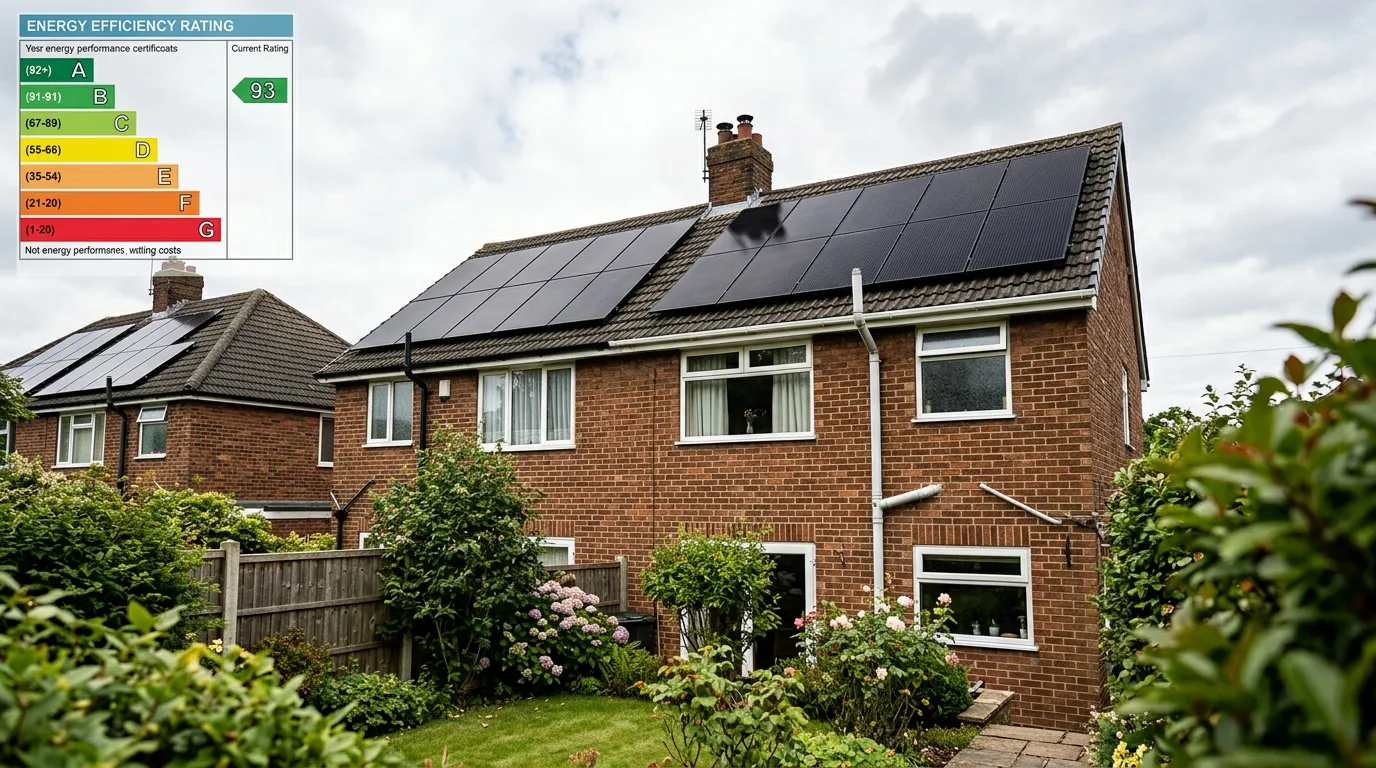
TL;DR
- An EPC is a snapshot - it only reflects what was there when the assessor visited
- Adding solar panels after your EPC was issued does not automatically update your rating
- A 4 kW solar system on a C-rated home will very likely push it to Band B
- You need to book a new EPC assessment (typically £60–£120) to get the improvement on paper
- Have your MCS certificate and installation documents ready for the assessor
- Batteries help in practice but contribute less to the EPC score than generation capacity
- Quick wins like full LED lighting and heating controls can add a few extra points
We recently heard from a homeowner in Sandy, Bedfordshire - a fairly typical setup for a lot of UK homes - who had a question that comes up more often than you'd think:
"Our EPC from 2019 says we're a C (77 points). Since then we've installed a 4 kW solar panel system and a 4 kWh battery. Does this change our rating? And what do we actually need to do to get to B?"
Great question. The short answer is: yes, it almost certainly changes your rating - but only once you get a new EPC to reflect it. Here's what's going on, and exactly what to do about it.
Why your old EPC is out of date
An Energy Performance Certificate is a snapshot in time. It reflects the property as it was when the assessor visited. It cannot update itself when you make improvements - even significant ones.
The 2019 EPC for this Sandy property showed:
- Current score: 77 points (Band C)
- Potential score with solar (2.5 kWp recommended): 86 points (Band B)
Here's the thing: the homeowner didn't install 2.5 kWp of solar. They installed 4 kW - with a 4 kWh battery on top of that.
That means the improvement they've already made almost certainly exceeds what the EPC modelled as necessary to reach Band B. In theory, the rating upgrade is already sitting on the roof. It's just not on paper yet.
What you actually need to do: step by step
1. Book a new EPC assessment
This is the single most important step, and nothing else matters until you've done it.
A new EPC will allow a qualified assessor to record your current solar installation. The old certificate simply cannot reflect what's now on your roof.
Cost: typically £60-£120. Turnaround: usually within a week.
2. Have your documentation ready
When the assessor comes, show them:
- MCS certificate (Microgeneration Certification Scheme - issued at installation)
- Inverter make, model, and output (confirms the system size)
- System size: 4 kW panels + 4 kWh battery
- Installation invoice or commissioning sheet
The more evidence you can provide, the more confidently the assessor can score the system. Note that batteries don't always contribute significantly to the EPC score itself - the scoring methodology is more focused on generation capacity than storage - but having the full picture documented doesn't hurt.
3. Check your lighting
The 2019 EPC noted 90% LED lighting. If you've since completed the remaining 10%, that's a small but real additional improvement worth mentioning to the assessor. Full LED throughout gives you a marginally better score.
4. Verify your heating controls
Assessors will also look at:
- Room thermostat (present?)
- Thermostatic radiator valves (TRVs) on individual radiators
- Whether heating is programmable or smart-controlled
If any of these are missing, they're cheap to add and can nudge the score upward.
5. Check loft insulation hasn't settled
The 2019 EPC recorded 270mm of loft insulation - which is good. Over time, mineral wool can compress slightly. If it looks thin in places, topping it up is inexpensive and improves both your real-world energy use and your EPC score.
What's the likely outcome?
Based on the original EPC data and the installed system size, here's a reasonable expectation:
| Scenario | Estimated Score | Band |
|---|---|---|
| Original assessment (2019) | 77 | C |
| With 2.5 kWp solar (EPC modelled) | 86 | B |
| With 4 kW solar + 4 kWh battery | 84-89 (est.) | B |
This is not a guarantee - assessors use SAP methodology and results can vary based on how they record certain inputs - but the trajectory is clear. The solar upgrade alone is likely to be sufficient for Band B.
What might hold the score back?
The main factor working against a higher score is gas consumption. The property's estimated gas usage is around 9,700 kWh per year. That's not bad for a house of this size (around 130 m²), but gas heating is inherently less efficient under current EPC scoring than heat pump-based systems.
The high overnight electricity usage - approximately 5,200 kWh per year at night - may look unusual, but is easily explained by EV charging or overnight battery top-ups using cheaper off-peak tariffs. An assessor familiar with solar + battery setups will understand this.
What we would not bother with right now
If your only goal is to reach Band B, here's what's unlikely to be worth the investment:
- Solar thermal (hot water panels): expensive, modest EPC gain
- Heat pump: significant cost, and EPC scoring benefits are not always proportional unless the home is very well-insulated
- Window replacement: if you already have double glazing, additional gains are marginal
Focus on getting the new EPC first. There's a good chance the solar panels you already have are all you need.
The bottom line
You don't need a home renovation. You need a phone call to an accredited EPC assessor.
The work has already been done - it's just waiting to be officially recorded. Book the assessment, bring your MCS certificate, and there's a solid chance you'll walk away with a Band B certificate based on what's already installed.
If you're in a similar situation - a C-rated home that has since had solar, insulation, or other upgrades - the same advice applies. Your old EPC is telling the story of a house that no longer exists. Get it updated.
Have a question about your home's energy rating or efficiency improvements? Send it in - we may feature it in a future post.
The estimated scores in this article are based on the standard SAP 10.2 methodology used by UK EPC assessors. Actual results will depend on the specific property and assessor inputs. Always use an accredited assessor registered with an approved scheme such as Elmhurst Energy, NHER, or Stroma.