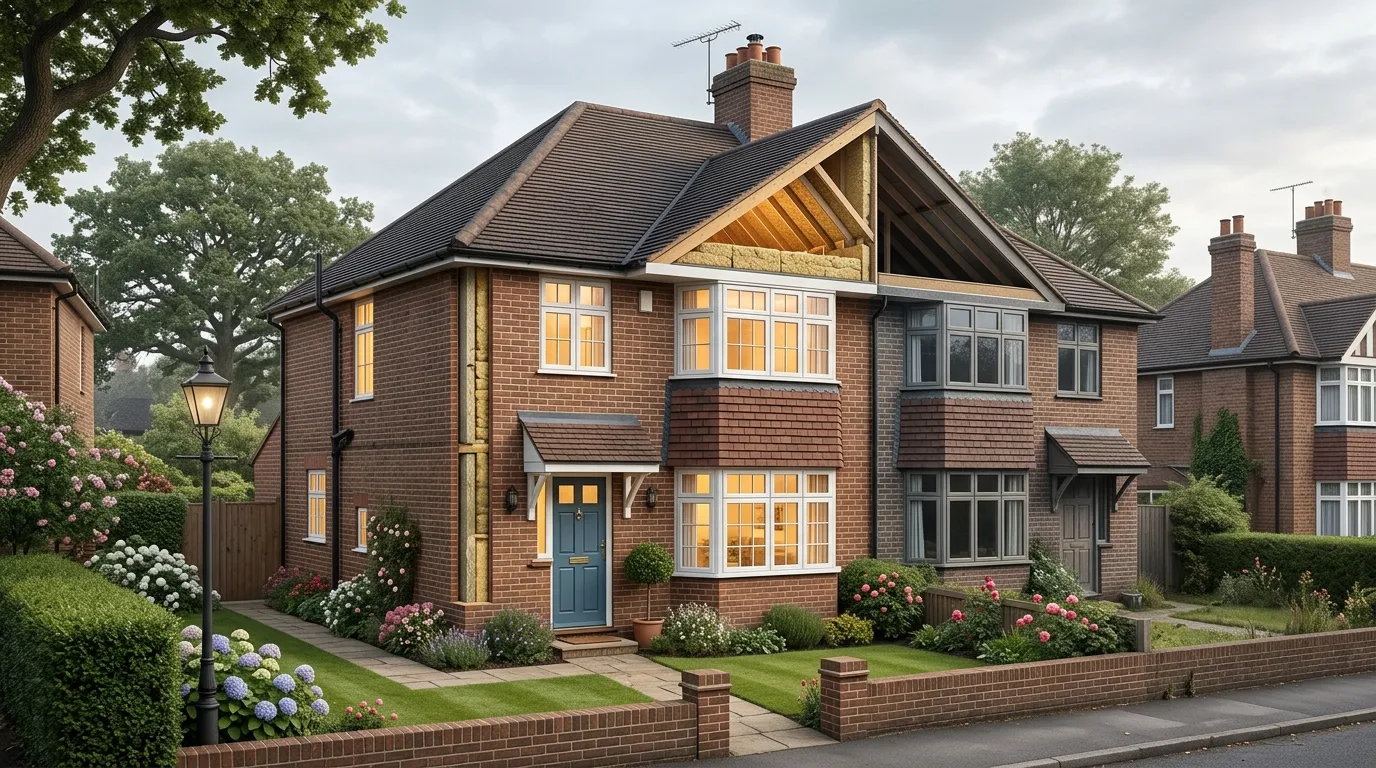
TL;DR
- Most unimproved interwar and post-war semis score D, often in the 52–62 SAP range
- Uninsulated cavity walls are the single biggest factor holding ratings down
- Loft insulation to 270mm is the cheapest and fastest route to meaningful improvement
- Moving from D to C typically costs £2,000–£4,000 without grant funding
- ECO4 has funded cavity and loft insulation at no cost for many eligible Bedfordshire and Cambridgeshire properties
- Properties close to the E/F boundary need attention now - not in 2030
The interwar and post-war semi-detached house is the dominant property type across much of Bedfordshire, Cambridgeshire and Hertfordshire. Drive through Sandy, St Neots, Letchworth, Huntingdon or the suburbs of Cambridge and the pattern repeats: pairs of brick-built semis with bay windows, pitched roofs, and side returns, most of them built between 1920 and 1965. They are solid, adaptable houses - but their energy performance tells a complicated story.
The Baseline: What Do These Houses Actually Score?
A typical unimproved 1930s or 1950s semi - cavity walls with no insulation, replacement double glazing, a gas combi boiler fitted within the last 15 years, partial loft insulation - will generally achieve a D rating. Most land in the 52 to 62 SAP point range, the lower half of Band D.
Properties at the lower end, particularly those with no loft insulation, older boilers, or significant remaining single glazing, can slip into Band E. That matters because Band E is the current legal minimum for rental properties - and a property sitting at 39 to 45 SAP points is close to the F threshold where letting becomes illegal.
Properties that have had cavity wall insulation installed, a new condensing boiler, full LED lighting, and 270mm of loft insulation will typically score mid to upper D - sometimes crossing into C, though that usually requires at least one further measure such as solar panels.
Two Properties, Different Outcomes
The contrast between two similar-looking semis in different states of improvement illustrates how much the rating can vary within the same property type.
The first is a 1938 bay-fronted semi in Royston, Hertfordshire - three bedrooms, gas combi boiler replaced in 2019, uPVC double glazing throughout, but no cavity wall insulation and only 100mm of loft insulation. The EPC comes back at D-57. The assessor's recommended measures: cavity wall insulation (estimated improvement: +6 SAP points), loft insulation top-up to 270mm (+4 points), and solar PV on the south-facing rear roof (+8 points). Combined, those three measures would push the property to C-75.
The second is a 1952 semi in Huntingdon, Cambridgeshire - similar size, similar boiler age, but cavity wall insulation was installed under the old CERT scheme in 2011, loft insulation is at 270mm, and the previous owner added a 2.5kWp solar array. That property scores C-72 on current assessment. Visually, you would not distinguish it from the Royston house driving past.
The gap between D-57 and C-72 is almost entirely explained by three measures that cost under £5,000 combined at today's prices - and in the Huntingdon case, the insulation was done for free.
Why These Houses Score Lower Than They Should
The SAP methodology treats several common features of interwar and post-war semis harshly, and for good reason.
Cavity wall construction without insulation. Houses built between roughly 1920 and 1980 typically have cavity walls, but the cavities were left empty. An uninsulated cavity wall has a U-value around three times worse than a properly insulated one. This single factor often accounts for a full band difference.
Older or oversized boilers. A 15-year-old combi boiler is not as efficient as it looks. The SAP methodology uses the SEDBUK database to rate specific boiler models, and older units - even those still functioning reliably - score worse than modern equivalents.
Lack of controls. Many older properties have basic TRVs rather than a full programmer-plus-room-thermostat arrangement. SAP rewards more sophisticated control systems.
Solid floor construction. Many 1930s semis have solid concrete ground floors with no insulation below. Ground floor heat loss is often underestimated and is factored into the SAP calculation.
What Actually Improves the Rating
1. Loft insulation to 270mm. If the loft is accessible and currently under-insulated, this is almost always the first measure. Cost is typically under £500 for a standard semi, disruption is minimal, and the SAP impact is 5–10 points - potentially a full band improvement on its own.
2. Cavity wall insulation. If the cavity is suitable - which most Bedfordshire and Cambridgeshire semis from this era are, provided the walls are in reasonable condition - filling it adds another 5–8 SAP points. A surveyor should assess suitability first, particularly for properties in exposed positions or with any existing damp.
3. Boiler replacement. If the existing boiler is more than 12 to 15 years old, replacing it with a modern A-rated condensing combi will improve the score. The exact improvement depends on the outgoing unit's efficiency rating, but gains of 3–6 points are typical.
4. Solar PV panels. A 3–4kWp array on a south or southwest-facing roof can push a mid-D property into Band C. The SAP methodology credits the energy generated against the property's primary energy demand.
The Realistic Cost of Moving from D to C
For a typical three-bedroom semi currently rated D-58, moving to Band C (69+) typically involves:
- Cavity wall insulation: £500–£1,200 (often partly or fully funded through ECO4 for eligible tenants)
- Loft insulation top-up: £300–£600
- Boiler replacement if required: £1,500–£2,500
Total outlay in the range of £2,000–£4,000 is realistic without grant assistance. ECO4 and the Great British Insulation Scheme have funded cavity wall and loft insulation for many properties across the region at no cost to the landlord, subject to the tenant's circumstances - worth investigating before spending your own money.
A Note on the 2030 Deadline
The current minimum for rental properties is Band E. The proposed trajectory raises that to Band C by 2030. For a property currently at D-58, that is achievable with a focused improvement programme. For a property at E-45, it requires more substantial work and the timeline matters.
If you own a 1930s or 1950s semi and are not sure where your rating currently sits, an up-to-date EPC is the starting point. We assess properties across Bedfordshire, Cambridgeshire and Hertfordshire. Book an assessment or read more about our EPC service.
---
Need an EPC assessment?
We provide EPC assessments across Bedfordshire, Cambridgeshire and Hertfordshire. Fast turnaround, accurate results.
Get in Touch