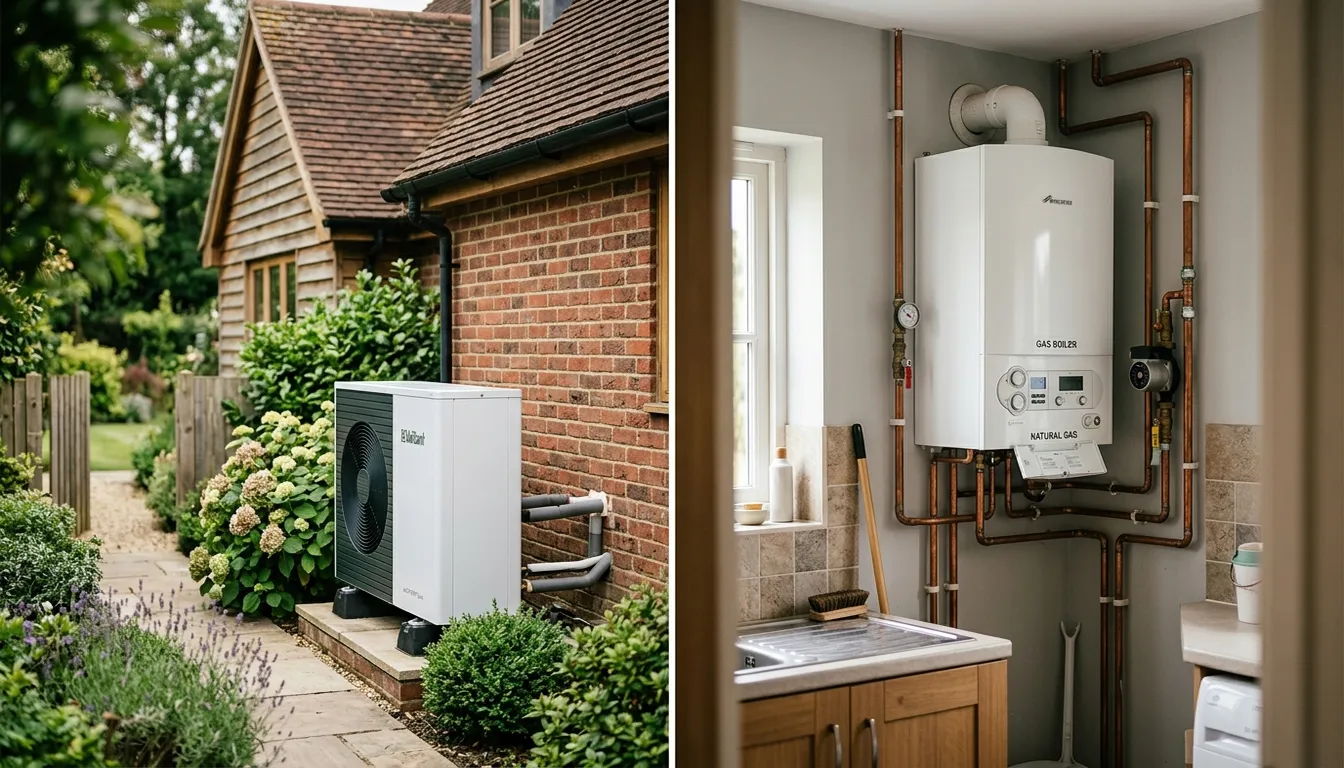
TL;DR
- Heat pumps and gas boilers are both valid options but perform differently based on property conditions
- In well-insulated homes, heat pumps offer greater efficiency and potential savings
- Gas boilers remain cost-effective for older, poorly insulated properties with high heating demands
- The Boiler Upgrade Scheme offers up to £7,500 in funding for heat pump installations
- Proper home insulation is essential - a fabric-first approach delivers maximum savings
- The decision should be based on EPC rating, property condition, and individual heat demands
The debate between heat pumps and gas boilers has become increasingly polarising. Media campaigns suggest one option is superior to the other, but the reality is more nuanced. Understanding when each system makes sense and how they actually perform in real-world settings requires looking beyond marketing slogans.
What Is a Heat Pump?
A heat pump is an electric device that moves heat from one location to another. In the context of home heating, it extracts heat from air, ground or water and transfers it into your home. This process is highly efficient, particularly when compared with direct electric resistance heating.
The efficiency is measured by the coefficient of performance (COP), which indicates how much heat output you get for every unit of electricity input. Modern air-source heat pumps typically have a COP between 2.5 and 4, meaning that for every kWh used, you get between 2.5 and 4 kWh of heat.
How Gas Boilers Work
A gas boiler burns natural gas to generate heat, which is then distributed through your home's heating system. This process converts chemical energy stored in gas into thermal energy that heats water or air.
Modern condensing gas boilers are highly efficient, typically achieving around 90–95% efficiency when converting fuel to usable heat. The key performance metric here is the seasonal space heating efficiency (SSHE) which accounts for the actual performance over an entire heating season rather than just standalone tests.
Running Cost Comparison
When comparing running costs directly, it's essential to use realistic UK energy prices and understand how these translate into daily usage. Current UK electricity prices average around 24p/kWh while gas is approximately 7p/kWh.
This significant price difference means that a gas boiler used at peak efficiency can be cheaper for home heating than a heat pump when accounting for both electricity consumption and the fuel costs. However, this relationship changes significantly depending on your property's insulation and heating needs.
Cost Comparison Table
| System | Electricity Cost (p/kWh) | Gas Cost (p/kWh) | COP/SSHE | Effective Cost (p/kWh) |
|---|---|---|---|---|
| Heat Pump (COP = 3.0) | 24 | - | 3.0 | 8p/kWh |
| Gas Boiler (SSHE = 92%) | - | 7 | 0.92 | 7.6p/kWh |
Even at a relatively modest COP of 3, a heat pump becomes more cost-effective than a gas boiler when electricity is the primary energy source. The actual running costs will depend on the type of heat pump and local heating demands.
When Heat Pumps Make Sense
Heat pumps, particularly air-source models, excel in homes that are well-insulated and have a low thermal demand. In properties with EPC ratings of C or higher, heat pumps can offer significant savings due to their efficiency advantage. They also work best when heating requirements are consistent throughout the year.
- Well-insulated homes - A heat pump works more efficiently in a home that doesn't lose heat quickly. If your property is poorly insulated, you'll waste energy heating it, so the economic benefits are reduced.
- Low thermal demand - Properties where heating isn't required all day long benefit more from heat pumps. The continuous efficiency of heat pumps can be particularly valuable in homes with lower heat loads.
- EPC rating C or above - Homes rated at EPC C or better make excellent candidates for heat pump adoption. At these levels of efficiency, the system's advantages fully materialise.
- Availability of government grants - The Boiler Upgrade Scheme provides up to £7,500 in funding towards heat pump installations, making them financially accessible.
When Gas Boilers Remain the Better Choice
In homes with poor insulation and high thermal demands, gas boilers can be more practical. This includes older Victorian terraces that were not built for heating efficiency, particularly those with no loft insulation or cavity wall insulation.
- Leaky Victorian terraces without fabric upgrades - These properties often have thermal demands so high that heat pump energy usage would be excessive. Installing a heat pump first and then retro-fitting better insulation is not recommended - the upfront cost of insulation improvements is much lower than the ongoing heat pump costs in these scenarios.
- Properties with low EPC ratings (D or below) - In such homes, both systems would consume significant energy to maintain comfortable temperatures, but a gas boiler is typically more economical for immediate heating needs.
- High heating demands - Especially in larger homes or those with high occupancy where constant heating is required, the efficiency advantages of heat pumps don't outweigh fuel costs in poorly insulated properties.
The Fabric-First Approach
Many of the current debates around heating systems miss a fundamental principle: improving your home's fabric - insulation, glazing, airtightness - should be the first step before upgrading heating systems.
The fabric-first approach focuses on minimising heat loss through better insulation and more efficient building construction, rather than on choosing high-performance heating systems. This strategy is particularly important in older properties where poor insulation will significantly reduce even the best heating system's value.
A home that is well-insulated will perform better with any heating source - heat pump or gas boiler - because it retains more heat for longer periods, reducing overall energy consumption and costs.
Government Grants and Financial Incentives
The Boiler Upgrade Scheme (BUS) provides up to £7,500 in funding towards heat pump installations - a significant incentive for homeowners considering upgrading. This grant is available for both air-source and ground-source heat pumps but has specific eligibility requirements.
For qualifying properties, especially those with EPC ratings B or C, this financial incentive makes heat pump technology financially viable to implement before making major insulation upgrades, but it's still important to ensure fabric improvements are made where practical.
Media Misrepresentation and Industry Campaigns
The narrative around heating systems has sometimes been distorted by industry campaigns that present extreme views. Both sides often oversimplify the decision-making process, which leads to confusion rather than clarity for potential homeowners.
Energy companies with existing gas infrastructure may promote gas boilers as essential when heat pumps offer a cleaner alternative. Similarly, heat pump manufacturers and green policy advocates can overstate the technology's benefits without considering practical limitations in older homes.
These campaigns often fail to account for several key factors:
- Household size and consumption patterns - Larger households with irregular heating needs may find heat pumps less economical.
- Property age and condition - Very old, poorly insulated properties don't benefit much from any heating technology.
- Financial incentives and accessibility - The cost-effectiveness varies significantly based on local funding availability.
COP Ratings Explained Simply
The coefficient of performance (COP) indicates the efficiency of a heat pump. Think of it as a measure of energy return on investment: for every unit of electricity you consume, how much heat do you get?
A COP of 3 means that for every kWh consumed by the heat pump, you get 3 kWh of heating output. This is much more efficient than an electric resistance heater, which has a COP of 1 (1kWh input = 1kWh output).
In gas boilers, we talk about seasonal space heating efficiencies (SSHE) that indicate how efficiently the boiler converts gas to usable heat throughout a full season. These measurements are more complex but provide a better picture of real-world performance.
Balanced Decision Making for Homeowners
The key is making an informed approach that considers the full context of your property and needs rather than following any one campaign. For most homeowners, this process should include:
- Assessing your current energy consumption - Understanding how much heat you actually use will help determine what system is most efficient for you.
- Evaluating your insulation levels - Before upgrading, it's worth considering if better fabric performance would improve efficiency more than changing heating sources.
- Understanding local government incentives - Grants like the Boiler Upgrade Scheme can dramatically change the economics of investment in heat pumps.
- Finding the right professional - A good energy assessor or heating engineer will help evaluate the best solution based on your specific situation and help you avoid misleading advice.
To make the most informed decision, it's worth getting a comprehensive home energy assessment that covers both your property's current condition and the likely performance of different system types.
Want expert guidance for your heating system choice?
Book a home energy assessment to determine the most cost-effective solution for your specific property and needs.
Get in Touch