TL;DR
- A loft conversion removes the ceiling insulation layer and moves it to the roof slope - this changes the SAP calculation significantly
- If you cannot prove what insulation was installed, the assessor must apply a conservative default
- Missing building control documentation is the most common cause of lower-than-expected EPC ratings in converted lofts
- Local authorities retain building control records - often longer than homeowners expect
- A post-conversion EPC should always be commissioned after the work is complete and signed off
A loft conversion changes your EPC in ways most homeowners do not anticipate. It can improve your rating, hold it steady, or - if the insulation work was done without proper documentation - lower it. Understanding why requires a brief look at how the SAP calculation treats roof and ceiling insulation, and what an assessor can and cannot assume when they visit.
How Loft Insulation Affects the SAP Calculation
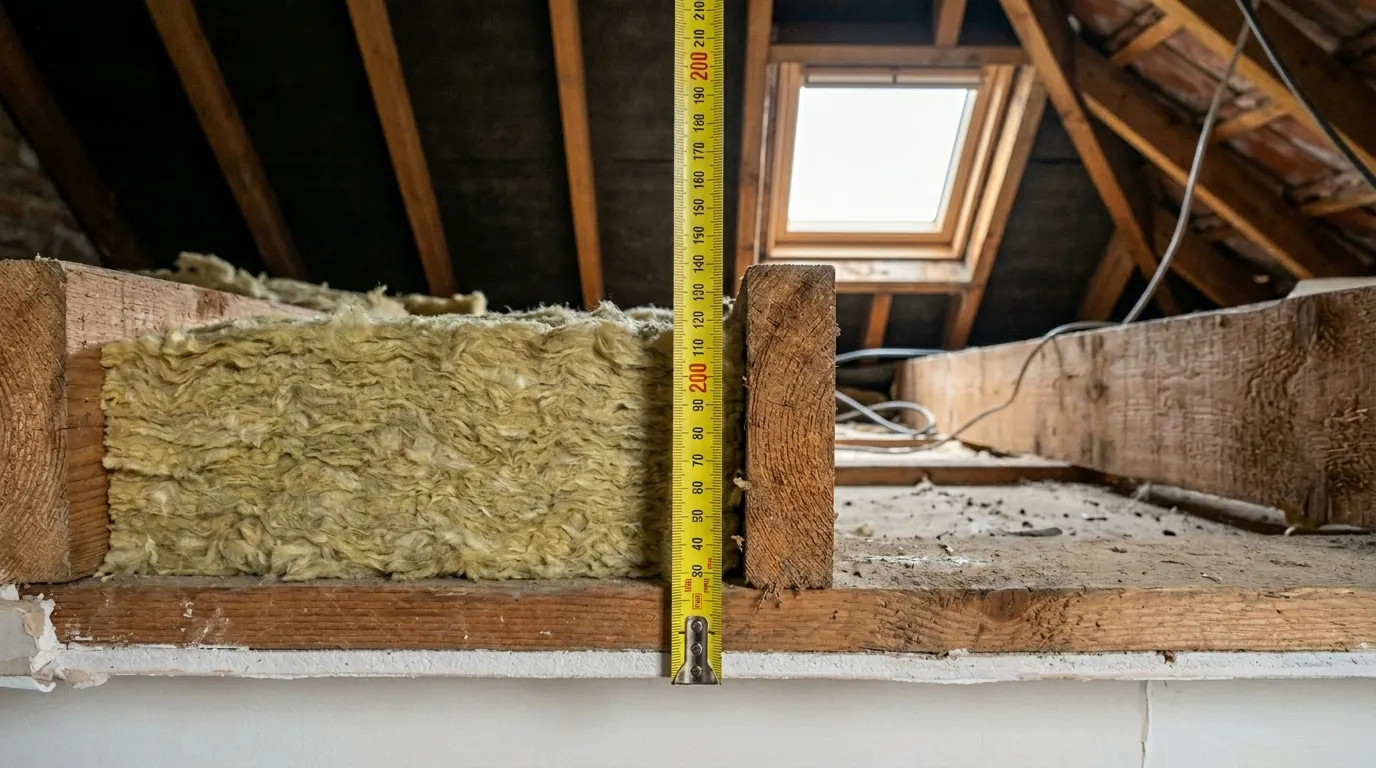
In an unconverted loft, the insulation sits on the floor of the loft space - mineral wool between and over the ceiling joists. The SAP calculation assesses the depth of this insulation (the recommended standard is 270mm) and applies the corresponding U-value to the ceiling.
When a loft is converted into habitable space, the ceiling insulation is removed and insulation moves to the roof slope - between the rafters, above them, or both. Achieving equivalent thermal performance in a pitched roof requires significantly more insulation depth, and the geometry of a typical rafter makes this difficult. A standard 100mm rafter filled completely with mineral wool gives a U-value around 0.40 W/m²K - considerably worse than 270mm of flat ceiling insulation, which achieves around 0.13 W/m²K.
Getting close to current Part L standards (0.18 W/m²K or better for pitched roofs) generally requires insulation below the rafter as well, reducing ceiling height slightly.
What the Assessor Looks For
When an assessor visits a property with a converted loft, three things happen.
First, they identify that the loft has been converted and add the floor area to the total heated floor area of the property - this changes the calculation baseline.
Second, they need to assign a U-value to the roof slope. If documentation is available, they use the actual construction U-value. If it is not, they apply an age-based default for the roof slope - which for conversions done before 2000 can be quite poor.
Third, they record any available evidence: building control completion certificate, contractor specification, visible insulation in eaves storage areas, or a previous EPC that already records the conversion.
If none of these exist, the assessor applies the default. In many cases this produces a worse U-value than what is actually installed.
The Documentation Problem in Practice
This scenario is representative of what comes up regularly in the region.
A property in Stevenage, Hertfordshire - a 1960s semi with a loft conversion carried out in approximately 2004 - was brought to market in early 2026. The seller had owned it for eight years and had no documentation from the conversion, which was done by the previous owners. The estate agent requested a new EPC. The assessor found no building control records, no specification, and the eaves cupboard was fully boarded over with no inspectable section. The conversion was assessed using the pre-2006 default for pitched roofs - a U-value of 0.35 W/m²K - and the property came back at D-54 rather than the C-70 the seller had expected based on the property's otherwise reasonable specification.
The same issue came up on a purchase in St Neots, Cambridgeshire, where a buyer's solicitor flagged that the EPC for the property - a 1950s semi with a dormer conversion - had been assessed using default values and the actual insulation standard was unknown. The buyer commissioned a thermal imaging survey before exchange, which provided enough corroborating evidence of the roof's performance to allow the assessor to apply a more favourable convention. The reassessed certificate came back at C-69.
The contrast between these two outcomes - one where documentation was unavailable and nothing could be done before sale, one where an additional survey bridged the gap - illustrates both the problem and the solution.
Recovering Lost Documentation
If you own a property with a converted loft and no paperwork, there are practical options before assuming the worst.
Contact the local authority building control department. Central Bedfordshire Council, Bedford Borough Council, Cambridge City Council and Hertfordshire's various councils all retain building control records, often for fifteen to twenty years. A subject access request or simple written enquiry will tell you whether a completion certificate was issued. If it was, you can often obtain a copy.
Check the eaves. Many loft conversions include a small storage area behind the knee wall where the insulation layer transitions from ceiling to slope. If this area is accessible and the insulation is visible and measurable, the assessor can use actual measured depths rather than defaults.
Commission a thermal imaging survey. A thermal imaging survey conducted in cold weather can demonstrate insulation performance across the roof slope. It is not a direct substitute for construction data, but it provides corroborating evidence that an assessor can take into account.
Check previous EPCs on the register. If the property was assessed after the conversion was completed, the previous certificate may already record the loft conversion details - including the insulation standard used at the time.
For Landlords Planning a Conversion
If you are planning a loft conversion on a rental property and the EPC matters - particularly if the property is approaching a MEES threshold - talk to your architect or builder early about insulation specification and documentation.
The marginal cost of specifying 150mm between rafters plus 50mm below rafter, rather than 100mm between rafters only, is small at construction stage. The EPC benefit is significant. Retain all documentation: the building control completion certificate, the insulation product data sheets, and the contractor's specification. These will be needed for every EPC assessment the property ever has.
A landlord in Huntingdon went through this process on a 1940s semi where the existing loft was uninsulated and unusable. The conversion was specified to current Part L standards, fully documented, and assessed immediately after practical completion. The property moved from D-55 to C-71 - a full band and a half improvement - and the landlord now has a certified basis for the rating that will support every future assessment.
Getting a Post-Conversion EPC
If you have recently completed a loft conversion, the most useful step is to commission a new EPC once the work is finished and signed off. The certificate will reflect the actual property configuration and give you an accurate baseline.
We carry out EPC assessments on properties with loft conversions across Bedfordshire, Cambridgeshire and Hertfordshire. If you have documentation questions before the visit, contact us first - it saves time on site and produces a more accurate result.
---
Need an EPC assessment?
We provide EPC assessments across Bedfordshire, Cambridgeshire and Hertfordshire. Fast turnaround, accurate results.
Get in Touch