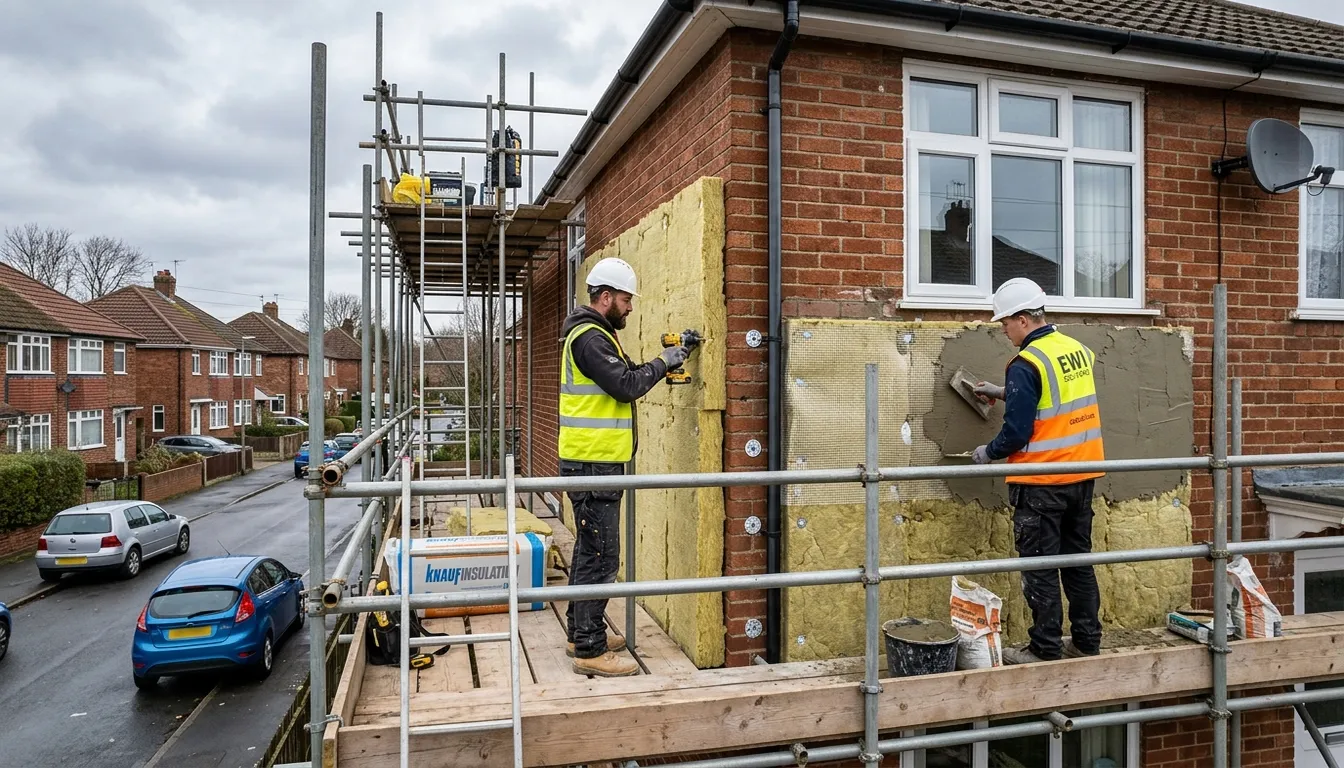
Buildings account for a significant share of UK energy consumption. For developers, facilities managers, and commercial landlords, getting insulation right is both a regulatory requirement and a direct way to cut operating costs. This guide covers material selection, installation best practices, and the financial case for upgrading insulation in commercial properties.
Why Insulation Matters for Commercial Buildings
Heat loss through walls, roofs, and floors is the single largest source of wasted energy in most commercial buildings. According to the Energy Saving Trust, properly insulated commercial properties can reduce heating demand by 25-35% compared to uninsulated equivalents.
Beyond energy bills, insulation directly affects your Energy Performance Certificate (EPC) rating. Under the current Minimum Energy Efficiency Standards (MEES), commercial properties must meet a minimum EPC rating of E to be legally let. With the proposed tightening to Band B by 2030, buildings with poor insulation face the real prospect of becoming unlettable.
There is also a rental premium at stake. Better-rated buildings consistently attract higher rents and lower void periods, making insulation one of the most straightforward ways to protect and improve property value.
Material Selection: Matching the Right Product to the Job
Not all insulation materials perform equally, and the best choice depends on the building type, available space, and whether the project is a new build or retrofit. Here are the most common options for commercial applications:
Rigid PIR Boards
Polyisocyanurate (PIR) boards offer the highest thermal resistance per unit thickness, with typical R-values around 3.8-4.0 m²K/W per 100mm. This makes them well suited to new constructions and situations where wall depth is limited. PIR also minimises thermal bridging at structural junctions when installed continuously.
Mineral Wool
Available as rock wool or glass wool, mineral wool is widely used in commercial settings for its fire resistance (non-combustible, Euroclass A1) and acoustic properties. Thermal performance is moderate - typically around 2.5-3.0 m²K/W per 100mm - but it remains a cost-effective and well-understood option, particularly for cavity walls and steel-framed buildings.
Cellulose (Recycled Paper)
Blown cellulose insulation works well for retrofit projects where access is limited. It fills irregular cavities effectively and has good thermal performance at around 3.5 m²K/W per 100mm. Its carbon footprint is lower than most alternatives, which matters for projects targeting BREEAM or similar environmental ratings.
Sheep's Wool
A niche but effective choice, particularly for older or heritage buildings. Sheep's wool is naturally breathable and manages moisture well - a significant advantage in properties where vapour control is difficult. Thermal performance sits around 3.3 m²K/W per 100mm. Material costs are higher than mineral wool, but reduced risk of condensation problems can offset this over time.
Quick Comparison
PIR boards for maximum performance in minimal thickness
Cellulose or mineral wool, depending on access and fire requirements
Sheep's wool or wood fibre for breathability and moisture management
Installation: Where Most Problems Start
Even the best insulation material underperforms when installed poorly. The most common issues we see in commercial buildings are:
- Thermal bridging: Gaps at window frames, floor/ceiling junctions, and structural connections create cold spots that can reduce overall wall performance significantly. Continuous insulation coverage across all elements is the only reliable prevention.
- Compression: Insulation that is squeezed or forced into spaces loses thermal resistance. A 100mm batt compressed to 75mm does not perform like a 75mm batt - it performs worse than either, because the compressed fibres lose their ability to trap still air.
- Gaps and voids: Even small gaps around pipes, cables, and service penetrations allow convective heat loss that bypasses the insulation entirely. Attention to detail during installation is not optional.
- Moisture barriers: In commercial roofing and wall systems, incorrect placement of vapour control layers can trap moisture within the insulation, reducing its effectiveness and causing long-term damage to the building fabric.
Verification: Thermal Imaging and Airtightness
Post-installation verification is the step most often skipped - and the one that matters most. A thermal imaging survey carried out after insulation installation will immediately reveal gaps, cold bridges, and areas of poor coverage that are invisible to the naked eye.
For commercial properties, thermal imaging typically costs a few hundred pounds depending on building size - a small price compared to years of wasted energy from undetected installation defects.
Pairing insulation upgrades with an airtightness test provides a complete picture. Insulation controls conductive heat loss; airtightness controls convective loss. Addressing both together delivers the best results.
UK Regulations and Compliance
Commercial insulation projects must comply with Part L of the Building Regulations (Conservation of Fuel and Power), which sets minimum U-values for building elements:
- Walls: 0.26 W/m²K for new builds, 0.30 W/m²K for existing buildings undergoing major renovation
- Roofs: 0.16 W/m²K for new builds, 0.18 W/m²K for renovations
- Floors: 0.18 W/m²K for new builds, 0.22 W/m²K for renovations
These values were tightened in the 2021 update to Part L, and further revisions are expected as the UK moves toward its 2050 net zero target. Specifying insulation that meets or exceeds current requirements provides some protection against future regulatory tightening.
For let commercial properties, MEES compliance is also a factor. A building with poor insulation is unlikely to achieve the EPC ratings needed to remain legally lettable under current or proposed standards.
The Financial Case
Installation costs for commercial insulation vary widely depending on material, building type, and access. As a rough guide:
- Cavity wall insulation: £15-25 per m² for straightforward installations
- External wall insulation: £80-120 per m² including render finish
- Roof insulation: £20-40 per m² depending on roof type
- PIR board (internal): £30-50 per m² including battening and boarding
Energy savings depend on the starting condition of the building, but commercial properties that upgrade from minimal to compliant insulation typically see heating costs drop by a quarter to a third. For a medium-sized office or retail unit, this can mean several thousand pounds in annual savings.
Funding support may be available through the Energy Company Obligation (ECO) scheme for qualifying projects. The scheme periodically changes its eligibility criteria, so it is worth checking current conditions before starting work.
When combined with improved EPC ratings, higher rental values, and reduced maintenance costs from better-controlled internal environments, the payback period for commercial insulation upgrades is typically five to eight years.
Getting It Right First Time
Insulation is one of those building elements where getting it right during installation is far cheaper than fixing it afterwards. Walls get boarded over, ceilings get finished, and access becomes difficult or impossible. The time to verify quality is during the work, not after the building is occupied and energy bills are higher than expected.
A proper approach includes: selecting materials matched to the building type, ensuring continuous coverage without gaps or compression, verifying performance with thermal imaging, and testing airtightness to confirm the building envelope works as a complete system.
Need an insulation assessment for your commercial property?
We provide thermal imaging surveys, airtightness testing, and energy assessments for commercial buildings across Bedfordshire, Cambridgeshire, and Hertfordshire. Get a clear picture of where your building is losing heat and what to do about it.
Get in Touch