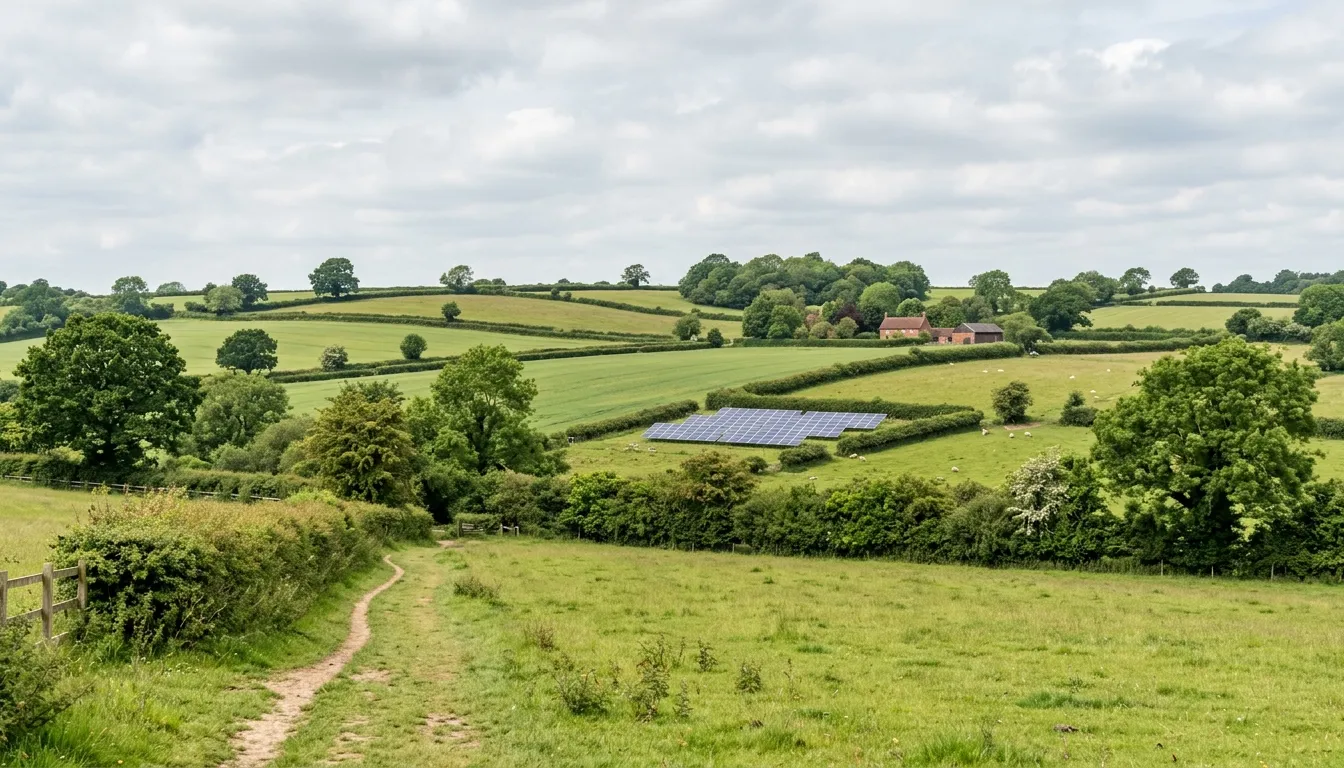
There is a piece of land between Stevenage and Walkern, near Aston End, that I pass almost every day. A while back the protest signs appeared. The objecting voices. That familiar "not here" feeling. When that happens you automatically assume something big is coming. A solar farm swallowing the countryside. That is what I assumed too, until I pulled up the planning documents.
This is a tiny project
The entire installation is 2,100 square metres. That is 70 metres wide and 30 metres deep. Four rows of panels, 480 in total. The owner's full landholding is 31 hectares, and the solar section takes up 0.67 per cent of it.
Two thirds of one per cent. When I first read that figure I had to read it twice.
Across the remaining 99 per cent, the hedgerows stay, the willow stays, the birds stay, the cattle stay. Everything that was already there stays. The panels face south, roughly 2.3 metres off the ground at the back and 70 centimetres at the front. There is one small green electrical box - 3 by 3 metres - with two inverters inside. That is the full extent of the "industrial" presence.
The nearest dwelling is more than 500 metres away. The public footpaths all run more than 200 metres from the panels.
0.67%
of the landholding used for solar panels. The other 99.33% stays exactly as it is.
Seven representations. Not seven hundred.
The council received seven representations from residents. One was in support, one was neutral, five objected. Aston Parish Council took a neutral position. Some councillors objected, others thought the application was well set out.
Seven. Not a movement of thousands like the ones you read about in Wiltshire or Lincolnshire. Seven people wrote in, and from those seven a protest grew visible enough to catch the eye of anyone driving past.
The objections fell into familiar categories. I went through them all.
The arguments, examined
Loss of agricultural land. The installation is temporary - approved for 30 years, after which the land returns to agricultural use. And 99 per cent of the land stays untouched throughout. This is not a case of farmland being concreted over.
Landscape impact. I understand the emotional response to any new structure in a quiet rural setting. But the council's own landscape officer concluded that thanks to existing hedgerows and the undulating terrain, the panels will be barely visible. The visual impact is effectively negligible from public vantage points.
Wildlife. This one occupied me too, because I care about the birds around here. The approved plan includes a wildflower meadow under and around the panels, new hedgerow planting to the north and east, and an overall projected biodiversity increase of around 55 per cent. The site will be richer in wildlife after the project, not poorer.
Solar should go on rooftops and brownfield sites instead. I actually agree with this as a general principle. Rooftop solar should be standard on every new build. But that is a systemic question that a Hertfordshire winegrower cannot solve on our behalf. It is not a reason to reject one specific, small, well-designed ground installation.
The precedent argument. "If we allow this, where does it end?" I understand the fear. But a project should be judged on its own merits, not on what we imagine the future might bring.
The green belt question
This was the only objection with genuine professional weight. The land is part of the Metropolitan Green Belt, and the council's officer stated plainly that the project is, by definition, inappropriate development in the green belt. That is not nothing. Protecting the green belt is a real value that matters.
Permission was granted because the council judged that "very special circumstances" applied. The renewable energy contribution, the declared climate emergency, the temporary and fully reversible nature of the installation, the screening from public views, and the energy independence of a local agricultural business together outweighed the green belt harm.
It was a balancing exercise. Reading the committee report, it looks like an honest one.
Where I stand
I am not going to pretend the politics around net zero has not left a bad taste. It has. Too many instructions from above, too many distant decisions overriding local landscapes, too strong a sense that the train is leaving without rural communities on board. People are not angry because they are foolish. They are angry because they feel real things being lost.
But here is why I wrote this.
When I sat down and actually read the planning documents, this turned out to be a winegrower wanting to put panels on less than one per cent of his own land so that his farm and rural business can be energy independent. The surplus feeds into homes in the neighbouring villages. In 30 years everything is restored. In the meantime the landscape becomes richer in wildflowers and wildlife.
"If that is the face of net zero, then it is a face I can accept. More than that, it is one I can stand up for."
There is often a wide gap between the big words of politics and the small facts on the ground. This case is precisely about how the small facts are sometimes the more reassuring ones.
I walk past it every day. I saw the signs. Then I looked into it. And now I walk past with a smile.