You can have the best insulation, the most efficient boiler, and triple-glazed windows - but if your building leaks air like a sieve, you're still wasting energy and money. Airtightness is one of the most overlooked aspects of building performance, and the blower door test is how we measure it.
What Is a Blower Door Test?
A blower door test - sometimes called an air permeability test or air leakage test - is a standardised method for measuring how much air escapes through the fabric of a building. It quantifies the uncontrolled air leakage through gaps, cracks, and holes in the building envelope: the walls, floors, ceilings, windows, doors, and service penetrations.
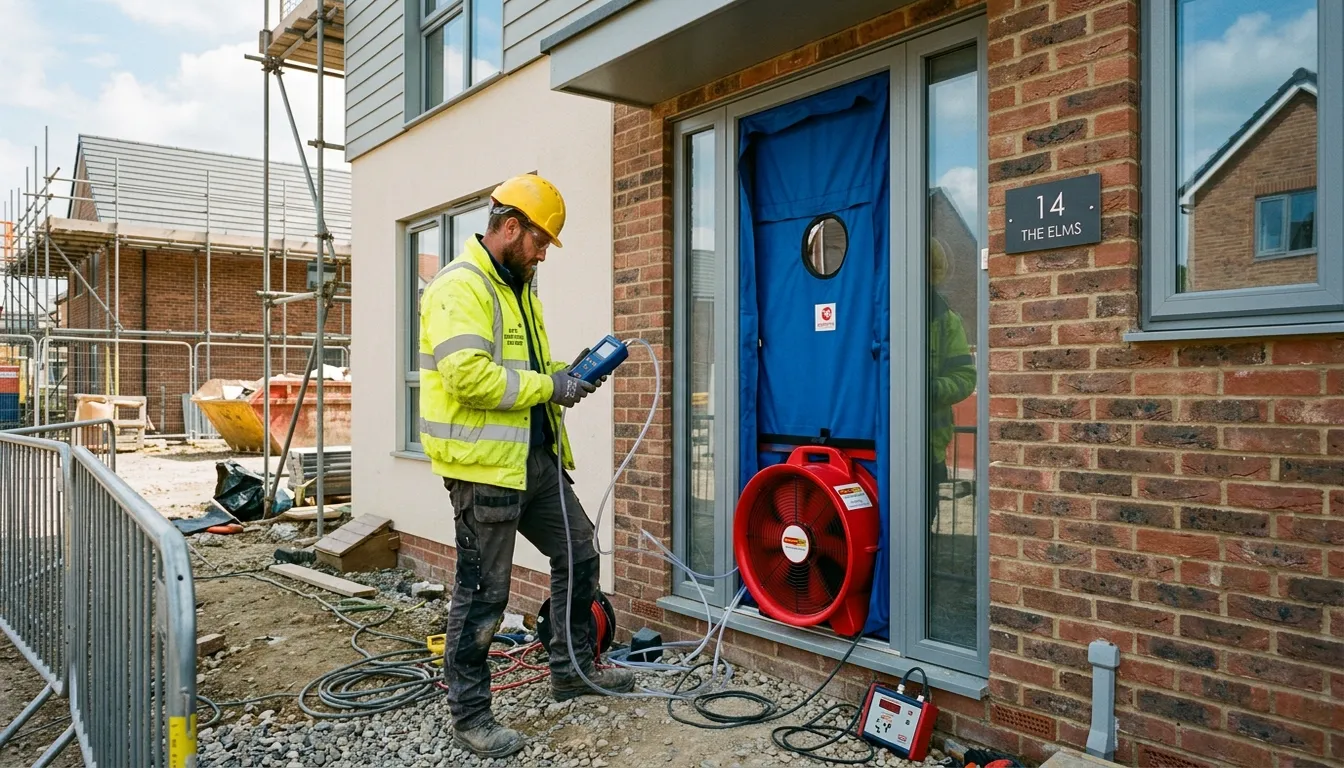
The test uses a calibrated fan temporarily sealed into an external doorway. The fan either pressurises or depressurises the building (or both), creating a pressure difference of 50 Pascals between inside and outside. At this controlled pressure, the equipment measures the total volume of air flowing through the fan - which equals the total air leaking through the building fabric.
The result is expressed as air permeability in cubic metres per hour per square metre of envelope area (m³/h·m²) at 50 Pascals. In the UK, this is the standard metric used for Building Regulations compliance.
Why Does Airtightness Matter?
Uncontrolled air leakage is responsible for a significant proportion of heat loss in most buildings - often 15–25% of total heat loss in a typical UK home. Unlike heat lost through walls, roofs, and windows (which can be reduced through insulation), air leakage bypasses insulation entirely. Warm air escapes through gaps; cold air infiltrates to replace it. Your heating system then works harder to compensate.
The consequences of poor airtightness extend well beyond energy waste:
- Higher energy bills: More air leakage means more energy required to maintain comfortable temperatures. In a poorly sealed home, you're effectively heating the outdoors.
- Comfort issues: Draughts, cold spots, and uneven temperatures are often caused by air infiltration rather than inadequate insulation.
- Moisture and condensation: Warm, moist air escaping through the building fabric can condense within wall cavities and roof spaces, leading to damp, mould, and structural damage over time.
- Noise: Gaps that let air through also let sound through. A tighter building envelope provides better acoustic insulation.
- Indoor air quality: While this might seem counterintuitive, uncontrolled air leakage doesn't equal good ventilation. Air leaking through wall cavities and floor voids can carry dust, pollutants, and fibres. Proper ventilation - controlled and filtered - is far more effective.
When Is a Blower Door Test Required?
Under Part L of the Building Regulations (Conservation of Fuel and Power), airtightness testing is required in several scenarios:
New Builds
All new dwellings in England must be pressure tested. The current Part L requirement (updated in June 2022) sets a maximum air permeability of 8 m³/h·m² at 50 Pa, though most new builds are designed to achieve significantly better results - typically 3–5 m³/h·m². The design target specified in the SAP calculation must be met or bettered on site.
Extensions and Conversions
While not always mandatory for extensions, Building Control officers increasingly request airtightness testing for larger extensions, barn conversions, and change-of-use projects. If the SAP calculation for the project assumes a specific air permeability figure, testing will be required to demonstrate compliance.
Commercial Buildings
Part L2 requires airtightness testing for new non-domestic buildings over 500 m² in floor area. The maximum permitted air permeability for commercial buildings is 10 m³/h·m² at 50 Pa.
Retrofit and Renovation
While not currently mandatory for existing homes, airtightness testing is increasingly used as a diagnostic tool during retrofit projects. Under PAS 2035, a whole-house retrofit approach should consider the building's airtightness and may include pre- and post-intervention testing to quantify improvements.
What Happens During a Blower Door Test?
The process is straightforward and non-invasive. Here's what to expect:
Preparation
All external doors and windows are closed. Internal doors are opened. Intentional ventilation openings (trickle vents, extract fans, chimneys) are sealed temporarily. This isolates the building so we're measuring only unintentional air leakage through the fabric.
Fan Installation
The blower door equipment - a calibrated fan with a flexible door panel - is fitted into an external doorway. The panel creates an airtight seal around the fan.
Pressurisation and Depressurisation
The fan runs at various speeds, creating a range of pressure differences. Sensors measure the pressure differential and airflow at each point. A standard test includes both pressurisation (blowing air in) and depressurisation (sucking air out) sequences.
Data Analysis
The test software plots the relationship between pressure and airflow, calculates the air permeability at 50 Pa, and generates a formal test report. The whole process typically takes 1–2 hours on site.
Understanding Your Results
The headline figure from a blower door test is the air permeability measured in m³/h·m² at 50 Pa. Here's how to interpret common ranges:
- Below 3 m³/h·m²: Excellent. Typical of well-built new homes and Passivhaus-standard buildings. At this level, mechanical ventilation with heat recovery (MVHR) is typically recommended to ensure adequate fresh air supply.
- 3–5 m³/h·m²: Good. Achievable with careful attention to airtightness during construction. Represents current best practice for standard new builds.
- 5–8 m³/h·m²: Acceptable. Meets Building Regulations but leaves room for improvement. Common in new builds where airtightness wasn't prioritised during construction.
- 8–15 m³/h·m²: Below current new-build standards. Typical of many existing UK homes built before 2006, when airtightness testing first became a requirement.
- Above 15 m³/h·m²: Poor. Common in older properties with suspended timber floors, single-glazed windows, and unlined chimneys. Significant energy savings are available through targeted sealing.
Common Air Leakage Paths
During a blower door test (particularly during depressurisation), it's often possible to feel where air is entering the building. Common leakage paths include:
- Around window and door frames - especially where sealant has cracked or was never applied
- Through letterboxes, keyholes, and cat flaps
- Around service penetrations - where pipes, cables, and ducts pass through the building envelope
- At the junction between walls and floors, particularly with suspended timber floors
- Through loft hatches that don't have adequate seals
- Around recessed downlights in ceilings below unheated loft spaces
- Through open chimneys and flues
- At the junction between different construction types - e.g., where an extension meets the original building
Identifying these paths is valuable because it allows targeted remediation. Many air leakage issues can be resolved with relatively inexpensive materials - sealant, expanding foam, draught strips, and purpose-made products - provided you know where the leaks are.
Airtightness and Ventilation: Getting the Balance Right
A common concern is that making a building too airtight will lead to stuffiness, poor air quality, or condensation. This concern is understandable but misplaced - provided ventilation is addressed properly.
The principle is straightforward: build tight, ventilate right. A well-sealed building with properly designed ventilation gives you control over air exchange. You choose when, where, and how much fresh air enters the building, rather than relying on random gaps and cracks. This approach delivers better air quality, lower energy bills, and reduced risk of condensation and mould.
For buildings achieving air permeability below 5 m³/h·m², mechanical ventilation - either centralised MVHR or decentralised extract - is typically the best approach. For buildings in the 5–10 range, background ventilators (trickle vents) combined with extract fans usually provide adequate air exchange.
Blower Door Testing in Bedfordshire, Cambridgeshire & Hertfordshire
At Waitz Energy, we carry out airtightness testing for new builds, extensions, conversions, and existing properties across Bedfordshire, Cambridgeshire and Hertfordshire. We use calibrated equipment compliant with BS EN ISO 9972 and the ATTMA TSL1 testing standard.
For new builds and compliance testing, we provide the formal test certificate required by Building Control. For existing properties and retrofit projects, we offer diagnostic testing that identifies specific leakage paths and provides practical recommendations for improvement.
Need an airtightness test?
Whether it's for Building Regulations compliance on a new build or a diagnostic test on an existing property, get in touch to discuss your requirements.
Request a Quote